
Public Speaking
Technical Jargon: When You Feel Comfortable but Your Audience Doesn't
Technical jargon can make you feel at home. When you've spent years building a product or working with a technology, its terminology comes naturally. Using it can feel easier than explaining complex ideas in everyday language, especially when you're under pressure.
But your audience may feel the opposite. Investors, clients, and non-technical colleagues have to spend extra mental effort decoding unfamiliar terms before they can understand your point. When that effort becomes too great, they may lose track of your message or disengage altogether.
Understanding is about more than transferring information.
Research on what makes people feel heard identifies mutual understanding as an important part of feeling respected and understood. Other research suggests that high-quality listening can foster a sense of warmth and connection between people.
But your audience may feel the opposite. Investors, clients, and non-technical colleagues have to spend extra mental effort decoding unfamiliar terms before they can understand your point. When that effort becomes too great, they may lose track of your message or disengage altogether.
Understanding is about more than transferring information.
Research on what makes people feel heard identifies mutual understanding as an important part of feeling respected and understood. Other research suggests that high-quality listening can foster a sense of warmth and connection between people.
These studies don't prove that avoiding jargon makes a presenter more likable, but they reinforce an important principle: communication works better when people can connect with what you're saying.
Know your audience before you prepare
Before building your presentation, ask yourself 3 questions:
- Who will be listening? Investors, clients, executives, and engineers have different backgrounds and priorities.
- What do they need to know? Investors may care about business value and competitive advantage. Clients may want to understand how a tool solves their problem. Engineering colleagues may need the technical details.
- What should they take away? Decide what your audience needs to understand, remember, or decide after the presentation.
Then adjust your content accordingly. Give people the information they need to understand your message and make informed decisions.
Explain the value before the mechanics
You don't have to eliminate technical terms. Give them context.
Instead of opening with:
“Our platform uses asynchronous processing to improve horizontal scalability,”
try:
“Our platform can handle more customer requests without slowing down the whole system. We achieve this through asynchronous processing.”
The technical term is still there, but the audience understands why it matters.
The same principle applies when presenting a tool to a client or explaining a technical decision to management: start with the problem, explain the benefit, and go deeper when the audience needs the detail.
Check how much effort your audience needs
It's hard to judge how easy your presentation is to follow when the terminology is already familiar to you.
LokiTalki's recording analysis includes Audience Load, which examines technical jargon, abbreviations, and dense technical phrases that may increase the mental effort required to follow your presentation.
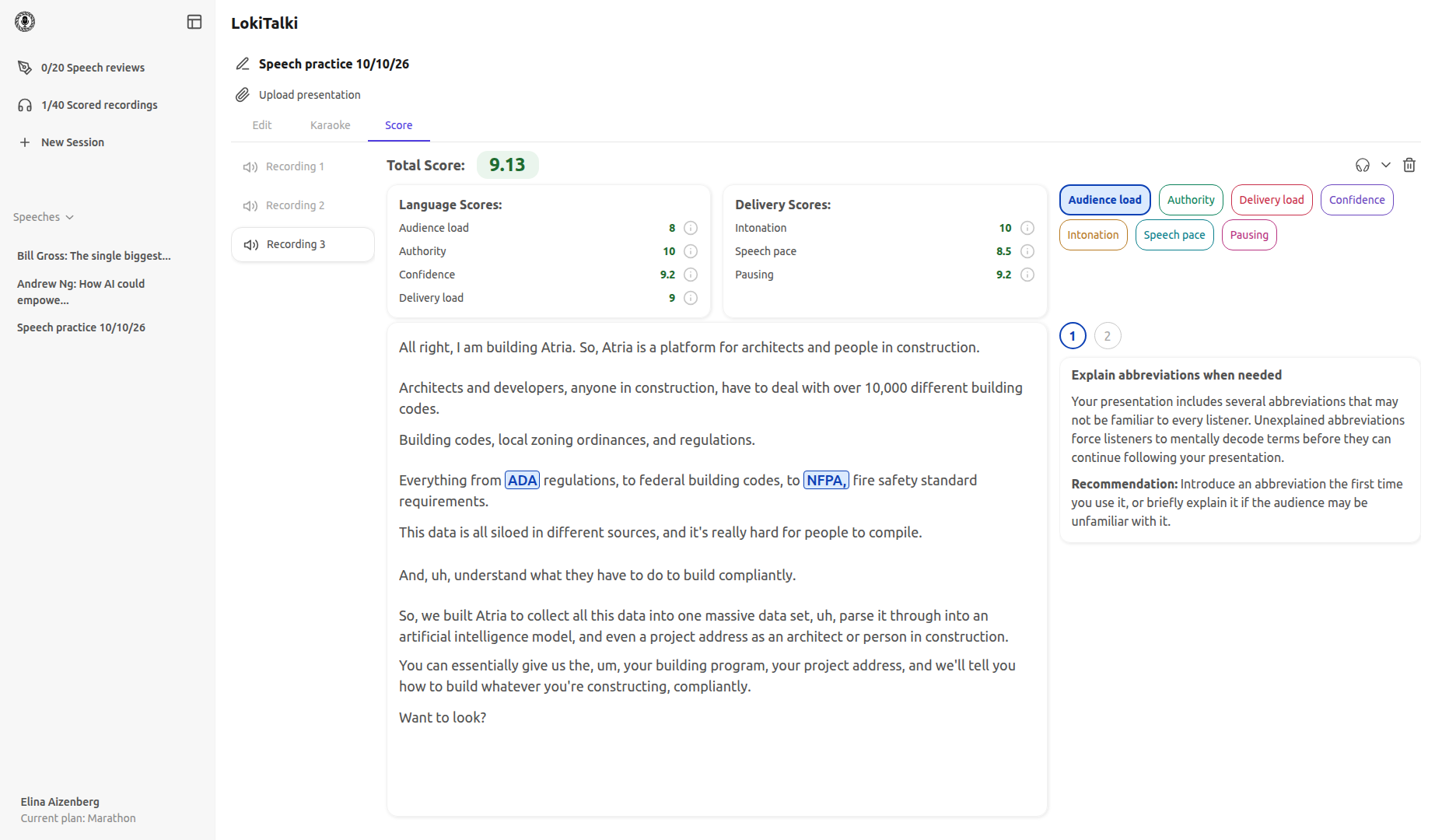
Use the feedback to identify passages worth reviewing. You might explain an unfamiliar term, split a dense sentence, or remove details your audience doesn't need. Keep the technical depth when it serves your purpose: a specialist audience may need precisely the terminology that would overwhelm someone else.
The goal isn't to sound less technical. It's to make your technical knowledge understandable and relevant to the people listening.
15.10.2026
See also